
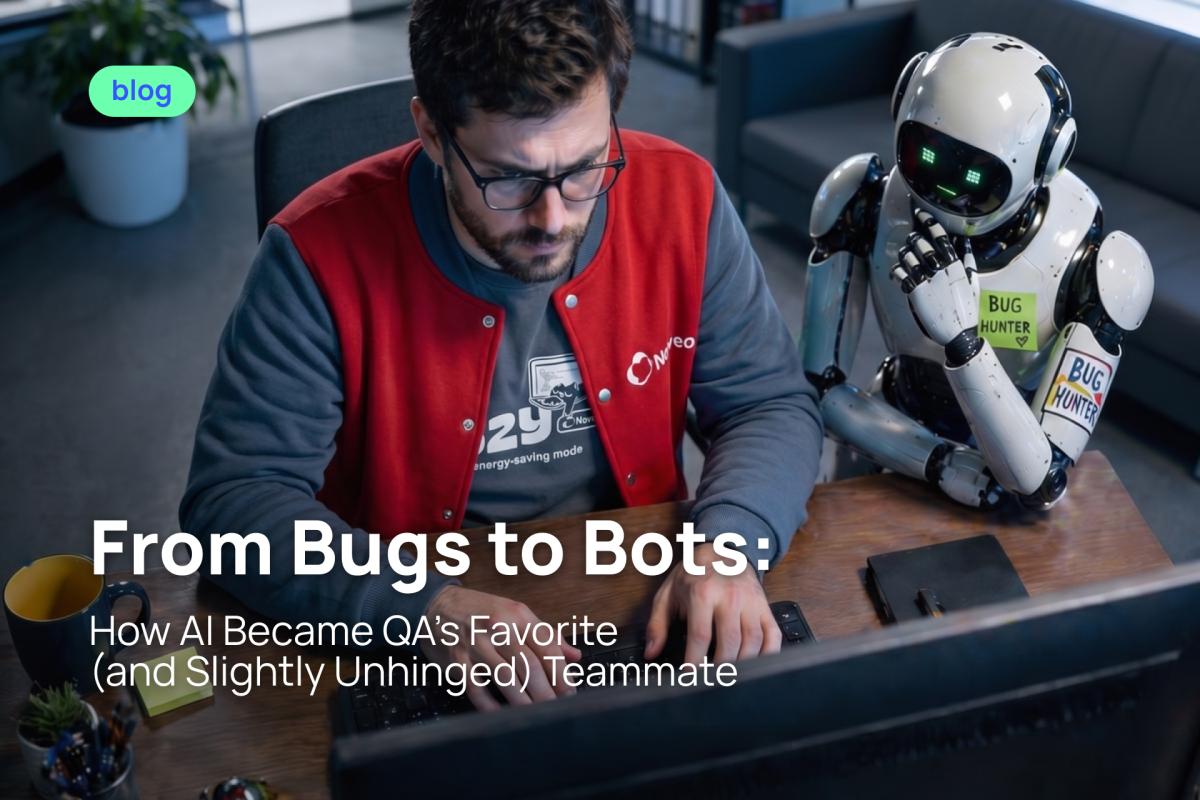
There was a time when a QA engineer’s closest allies were a strong cup of coffee, an endless checklist of test cases, and that one bug that only showed up on Fridays at 5 PM (like it had a social life).
Today? There’s a new member on the team.
Not hired. Not onboarded. Not even approved by HR.
Large Language Models (LLMs).
Tools like ChatGPT didn’t politely ask for a seat at the table - they just showed up, started answering questions, writing test cases, and occasionally hallucinating their way into chaos. And somehow… they stayed.
So What Exactly Are We Dealing With?
LLMs aren’t just another overhyped LinkedIn buzzword people throw around between "growth mindset" and "synergy."
They are systems trained on massive amounts of data that can:
- understand language
- generate content
- write code
- assist with reasoning
In simpler terms:
Imagine a junior QA + developer + analyst + documentation writer rolled into one.
Now remove the coffee breaks, salary expectations, and ability to admit "I don’t know."
That’s your AI assistant.
🧠 Why This Exists (Spoiler: It’s Not Magic)
Generative AI didn’t appear out of nowhere like a production bug nobody can reproduce. It’s built on three core pillars:
- Data (A Lot of It)
We’re talking documentation, codebases, articles, conversations - basically the internet in all its brilliance and absolute nonsense.
That’s why AI can:
- give you a brilliant solution…
- or confidently recommend something that should never exist in any environment, ever
Same source. Different outcomes.
2. Compute Power
Training these models requires serious infrastructure:
- GPUs running for weeks
- distributed systems working overtime
Without modern computing, LLMs would still be sitting quietly inside research papers that nobody reads past page three.
3. Algorithms (The Transformer Breakthrough)
The real game-changer is the transformer architecture.
It allows models to:
- understand context
- process sequences
- generate coherent responses
In QA terms, this is groundbreaking.
It’s like a system that reads your bug report… and actually understands it.
Yes, shocking. We’ve all suffered enough to appreciate this.
🧩 What’s Actually Happening Behind the Curtain?
Here’s the uncomfortable truth:
LLMs don’t "know" anything.
They don’t think: "Let me recall the correct answer."
They operate more like: "What sequence of words is most likely to come next?"
And somehow, through probability, patterns, and a little bit of chaos, it works.
Most of the time.
🚀 Why This Feels Different From Old-School Tools
Autocomplete has existed forever. Nobody was writing think pieces about it.
So what changed?
- Context awareness → it understands full prompts, not just keywords
- Generative ability → it creates, not just retrieves
- Adaptability → works across QA, code, SQL, documentation
- Speed → instant output
It’s autocomplete… but it went to university and came back slightly overconfident.
⚙️ What AI Can Actually Do for QA
Let’s drop the hype and talk reality.
LLMs can:
- generate test cases and bug reports
- write and explain code
- suggest edge cases you didn’t think about
- help with SQL and data validation
- summarize requirements
- brainstorm scenarios
They don’t just answer questions. They expand your thinking.
And sometimes… they expand it in completely unnecessary directions. But still.
🧭 AI Fluency: The Difference Between Using It and Actually Using It
Not all QA engineers use AI the same way. And it shows.
🟢 Level 1: Consumer
You ask. You copy. You hope.
"Generate test cases for login."
Minimal effort. Maximum faith.
🟡 Level 2: Collaborator
You refine. You validate. You iterate.
"Add edge cases. Include rate limiting. Consider invalid tokens."
Now we’re getting somewhere.
🔴 Level 3: Orchestrator
You guide AI with domain expertise.
You challenge it. You shape it.
This is where real QA engineers operate.
🔄 The Three QA Instincts Applied to AI
- Asking (Basic Survival Mode)
You ask → AI answers → you move on.
2. Refining (Where Quality Begins)
You push further:
- "Make it realistic "
- "Focus on API failures"
- "Add negative scenarios"
This is where results improve.
3. Challenging (The QA Personality Trait 😏)
You don’t trust it.
You ask:
- "Are you sure? "
- "What could go wrong? "
- "What’s missing? "
Congratulations. You are now testing the AI.
🧪 Manual Testing: Now With a Second Brain
Manual testing was never about clicking buttons. It’s about asking:
"What could go wrong?"
LLMs are very good at helping you answer that - sometimes too enthusiastically.
🔍 Test Case Creation
No more staring at requirements like:
"Yes… this is definitely… a feature."
You get:
- structured scenarios
- edge cases
- unexpected ideas
Not perfect. But a powerful starting point.
🐞 Bug Reporting
From:
"It’s broken."
To:
"The Submit action fails silently after validation succeeds, resulting in no request being sent."
Same issue. Completely different developer reaction.
🔎 Exploratory Testing
AI suggests:
- weird user behavior
- hidden edge cases
- failure paths
Some are obvious.
Some are brilliant.
Some make you question reality.
🧬 Test Data Generation
Finally, an escape from:
- test1@test.com
- test2@test.com
We’ve all committed this crime.
⚙️ Automation: Your Slightly Chaotic Co-Pilot
💻 Test Script Generation
- Boilerplate? Done.
- Examples? Done.
- Almost-working code that needs fixing? Absolutely done.
Still faster than starting from scratch.
🔧 Debugging
Paste an error. Get an explanation.
Sometimes helpful.
Sometimes confusing.
Always faster than staring at logs in existential despair.
🔁 Refactoring
AI helps clean:
- messy test scripts
- duplicated logic
- questionable structure
And the best part?
It doesn’t judge you. Unlike your teammates.
🧩 Everyday QA Tasks, Now Less Painful
📊 SQL & Data Validation
- write queries
- debug joins
- explain logic
Your unofficial database assistant has arrived.
📝 Documentation
- test plans
- reports
- stakeholder messages
Less time writing. More time actually testing.
🎯 Requirement Understanding
From:
"What is this even supposed to do?"
To:
"Okay… I can test this."
Progress.
⚠️ Reality Check (Because We’re QA, Not Dreamers)
Let’s not romanticize this.
LLMs:
- hallucinate
- lack context
- are confidently wrong
Which makes them…
A very smart intern.
Helpful? Yes.
Reliable without supervision? Absolutely not.
💡 Final Thought
LLMs are not replacing QA engineers.
They are:
- speeding us up
- sharpening our thinking
- removing repetitive work
The real shift isn’t automation.
It’s AI-augmented thinking.
🔥 Closing Line
The best QA engineers won’t be replaced by AI.
They’ll just have:
- better test coverage
- cleaner bug reports
- faster workflows
…and significantly less patience for writing
test123@test.com
And honestly?
That’s progress.
